
It’s one of the most common complaints we hear from landlords, managing agents and tenants across Liverpool: the fire door is so hard to shut that it stops a few millimetres short of the frame, or it closes but never quite latches. Sooner or later someone wedges it open, takes the closer off or picks the smoke seal out of the frame, and a door that was meant to protect an escape route now protects nothing.
In almost every case the smoke seal gets the blame. Sometimes that’s fair, but more often the seal is only part of the story. This guide explains the different types of smoke seal (from the older brush seals to modern flipper and batwing seals), the real reasons a fire door fights you when it closes, how a competent installer fixes it, and what the law expects.
Why a fire door has to close and latch on its own
A fire door is only a fire door when it’s shut. Left open, or resting against the frame without latching, it lets fire and smoke straight into the escape route. That’s why fire doors in flats, HMOs and commercial buildings are fitted with a self-closing device, and why inspectors test the closing action before anything else.
Smoke is the bigger killer in most fires. Cold smoke spreads well before the heat arrives, which is why many fire doors carry an “S” in their rating, such as FD30S. The “S” means the fire door assembly has been tested to restrict the leakage of smoke at room temperature, and that depends on a smoke seal around the head and both jambs.
So the smoke seal has an important job. But it has to do that job without stopping the door from closing. Getting both right at once is where things go wrong.
Smoke seals and intumescent seals: what’s the difference?
People often mix the two up, so it’s worth being clear.
- Intumescent seals do nothing in everyday use. In a fire, the heat makes them expand and fill the gap between the door and the frame, holding back flames and hot smoke. They’re usually a strip set into a groove in the frame or the door edge.
- Smoke seals work all the time. They are always in contact with the door (or very close to it) to stop cold smoke getting through the gap before the intumescent seal has had time to react.
Some products combine both in one strip: an intumescent strip with a brush or flipper built into it. Others keep them separate, for example a “fire only” intumescent strip in the frame and a separate smoke seal on the door stop. Both approaches can be correct. What matters is that the seals fitted match the door’s certification and test evidence.
The types of smoke seal, from brush to batwing
Brush seals (the oldest type)
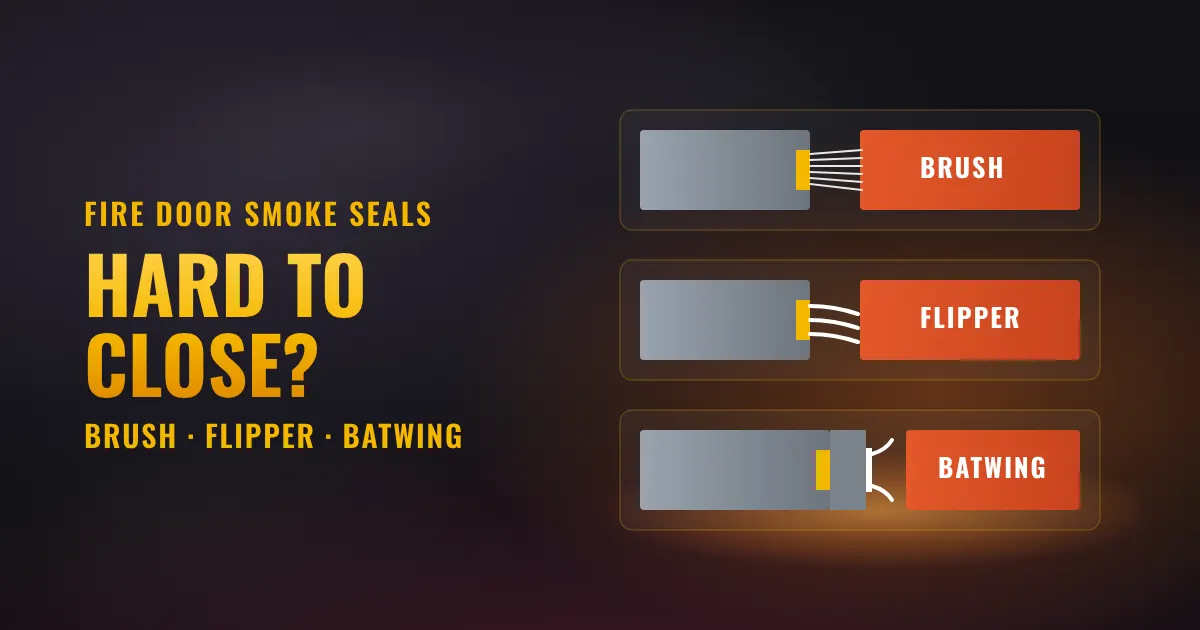
Brush seals were the first widely used smoke seals. A row of nylon or polypropylene bristles (a “pile”) sits in the middle of an intumescent strip or in its own carrier. When the door closes, the bristles sweep across the door edge and fill the gap.
They work, but they have well-known drawbacks:
- Friction. The bristles touch the door edge along its whole height, and they drag across it as the door swings shut. If the gap is tight or the brush stands too proud of its groove, that drag can be enough to stop a closer from latching the door.
- They change with age. Bristles flatten, splay, collect dust and grit, and stiffen when they’re painted over. A painted brush seal is one of the most common faults we find, and it both increases drag and stops the seal working.
- They’re hard to keep clean in kitchens, wet areas and busy communal corridors.
You’ll still find plenty of brush seals on older fire doors, and on some new ones where they form part of the tested specification. They aren’t wrong, but they are the type most likely to cause a hard-to-close door.
Flipper (fin) seals
Flipper seals, also called fin or blade seals, replaced brushes on many doors. Instead of bristles, one, two or three thin flexible fins (usually PVC or a similar polymer) sit in the intumescent strip. As the door closes, the fins fold over against the door edge rather than dragging bristles across it.
- Much lower resistance than a brush. Manufacturers describe them as low-resistance seals designed with accessibility in mind.
- Single, double or triple fins. More fins give a better smoke seal over a wider range of gaps, but slightly more resistance.
- Centre or offset. Fins can sit in the middle of the strip or towards one side, depending on how the door is hung.
- Easy to wipe clean, so they suit kitchens, bathrooms and care settings.
Pyroplex flipper seals are a well-known example, available in FD30 and FD60 sizes and tested for both fire and cold smoke leakage.
Batwing seals (on the door stop)
The batwing seal is a different idea altogether. Rather than sitting in the gap at the edge of the door, it’s fixed to the face of the door stop, the part of the frame the door closes against. Its two soft “wings” are pressed flat by the face of the door as it closes.
That makes a big difference to how the door feels:
- It compresses rather than drags. The door meets the seal face-on in the last moment of closing, instead of sweeping past it along the whole edge. There’s very little friction through the swing.
- Low closing force. The Lorient single Batwing (LAS1206), for example, is designed to keep opening and closing forces to a minimum, seals gaps of around 3 to 4mm, and is tested for cold smoke leakage to BS 476-31.1.
- Acoustic benefit. Batwing seals also cut noise between flats and corridors. The single Batwing is rated up to Rw 35dB.
- Easy to inspect and replace, because it sits on the stop rather than in a groove.
On our own installations we normally fit a 15mm fire-only intumescent seal in the frame and a 10mm single batwing smoke and acoustic seal on the door stop, where the door’s certification allows it. Keeping the fire seal and the smoke seal separate gives a door that seals well and still closes and latches cleanly with a correctly set closer.
Other options you’ll come across
- Compression and bubble seals. Rubber or silicone profiles set into the frame rebate or stop. Common on steel and composite fire doors, and on doors that also need draught or acoustic sealing.
- Combined intumescent and smoke strips. One strip with both functions, using a brush or flipper. Quick to fit, and common in communal residential blocks.
- Drop seals and threshold seals. For the gap under the door. An automatic drop seal stays up while the door moves and drops onto the floor or threshold as it closes, so it doesn’t drag across carpet. Not every fire door needs a bottom seal, but where one is part of the specification it must be the right type.
- Meeting-edge seals on double doors. Pairs of doors need seals where the two leaves meet, and often a selector so they close in the right order.
Smoke seal types compared
| Seal type | Where it fits | How it seals | Resistance when closing |
|---|---|---|---|
| Brush (oldest type) | In the intumescent strip, frame or door edge | Bristles sweep across the door edge | Highest: drags along the full height, worse when painted or dirty |
| Flipper / fin | In the intumescent strip, frame or door edge | Flexible fins fold over against the door edge | Low: designed as a low-resistance alternative to brush |
| Batwing | On the face of the door stop | Two soft wings compress flat against the door face | Low: compresses at the end of the swing instead of dragging |
| Compression / bubble | Frame rebate or stop | Rubber or silicone profile squashes against the door | Varies with profile and gap |
| Drop seal | Bottom of the door | Drops onto the floor or threshold as the door closes | Very low: lifts clear while the door moves |
The key point: you can’t simply swap one seal for another because it feels easier. Every certified fire door assembly is tested with specific seals. Any replacement must be the same, or must be covered by the door manufacturer’s or seal manufacturer’s test evidence for that door.
Why your fire door is hard to close
When a door won’t close or latch, the first job is to find out where the resistance actually comes from. These are the causes we find most often.
1. The wrong seal for the gap
Fire door gaps around the head and jambs are typically around 3mm, and usually no more than 4mm, depending on the certification. A seal sized for a 4mm gap fitted where the gap is 2mm will be squashed hard and fight the door. A brush seal in a tight gap is the classic example.
2. Seals fitted twice
Sometimes a combined intumescent strip with a brush is fitted in the frame, and then someone adds a separate smoke seal to the stop as well. Two smoke seals mean twice the resistance, and it isn’t what the door was tested with.
3. A seal sitting proud or out of its groove
If an intumescent strip isn’t fully pushed into its groove, or the groove was cut too shallow, the brush or fins stick out further than designed and drag across the door edge.
4. Painted seals
Paint on a brush or flipper makes it stiff, and paint on an intumescent seal can stop it expanding properly in a fire. Seals should never be painted. If they have been, they need replacing.
5. The closer isn’t set up for the door
Fire door closers are graded by power size under BS EN 1154. Power size 3 is the minimum for a fire door. A closer that is too weak, or one where the latching speed (the last 15° or so of the swing) has been turned down too far to stop slamming, won’t push the door past the seals and the latch.
Closers also lose performance as they wear, leak oil, or as the building changes with the seasons.
6. Hinges and a dropped door
Worn or loose hinges let the door drop on the closing side. The leading edge then catches the frame or the keep, and the gaps become uneven: tight in one place, wide in another. A door can also be “hinge bound”, where the hinge-side gap is too tight and the door springs back open. Fire doors normally need three fire-rated hinges (Grade 13 on most of the doors we fit).
7. A swollen, bowed or twisted door or frame
Timber moves. Damp, heating and poor storage before fitting can bow a door or twist a frame, so the door touches the stop at one corner before the rest. That corner then has to compress the seal on its own.
8. The latch and keep
A latch that doesn’t line up with the keep, or a keep fitted too tight, can make the door bounce off the frame even when the seals are fine. This is often mistaken for a seal problem.
9. Air pressure
Extractor fans, open windows, ventilation systems and long corridors can create a pressure difference across the door. A slight push from the air on the wrong side can be the difference between latching and not latching, especially in winter or on the windward side of a building.
10. Floors and thresholds
New carpet, laminate or a raised threshold can make the bottom of the door rub. It feels exactly like seal drag, but it’s coming from the floor.
How a competent installer fixes it
A good fire door installer or inspector won’t just turn the closer up. That makes the door harder to open, wears out the hinges and only hides the problem. Instead, the process should look like this:
- Test the closing action. Release the door from fully open, from about halfway and from a small opening, and watch where it slows or stops.
- Measure the gaps at the head and both jambs, at several points, with the door shut and latched. Uneven gaps point to hinges, swelling or a twisted frame.
- Check the seals. Are they the right type and size for the gap, seated properly, continuous, unpainted and undamaged? Are there two smoke seals where there should be one?
- Check the hinges and fixings. Tighten or replace worn hinges and stripped screws with like-for-like fire-rated parts.
- Check the latch and keep for alignment and adjust the keep if needed.
- Set the closer correctly. Adjust the closing speed and the latching speed so the door closes in a controlled way, then gives the final push to engage the latch. Change the power size only if the door’s width, weight or conditions need it.
- Replace seals with a compatible type if needed. Where an old brush seal is causing drag, a low-resistance flipper or a batwing seal may be the answer, but only where it’s covered by the door’s test evidence.
- Record what was done. Keep the paperwork with your fire safety records, including any replacement product details and certificates.
Most hard-to-close doors can be put right in a single visit. Where a door or frame is badly distorted, damaged or uncertified, a replacement certified fire door assembly is often the better long-term fix.
What you should never do
- Never cut, trim or pull out smoke seals or intumescent strips.
- Never wedge or prop a fire door open, or tape over the latch.
- Never disconnect or remove the closer.
- Never paint over seals.
- Never plane a fire door or add timber strips to “fix” gaps without checking what the door’s certification allows.
- Never swap in a different seal just because it’s what the shop had in stock.
Each of these can turn a working fire door into a liability, and can leave a landlord or responsible person exposed if there is a fire or an inspection.
Closing force vs opening force: getting the balance right
There’s a balance to strike. The door must close and latch reliably, but people still have to be able to open it, including children, older residents and wheelchair users.
Guidance under Approved Document M and BS 8300 says the opening force at the leading edge of a door should not exceed 30N between 0° and 30° of opening, and 22.5N between 30° and 60°. Low-resistance seals, good hinges and a correctly sized and adjusted closer are how you meet both requirements on the same door. Simply fitting a more powerful closer to overcome seal drag usually makes the door too heavy to open.
What the law and the standards say
- The Regulatory Reform (Fire Safety) Order 2005 puts a legal duty on the responsible person (often the landlord, freeholder or managing agent) to keep fire safety measures, including fire doors, in efficient working order and good repair.
- The Fire Safety (England) Regulations 2022, in force since 23 January 2023, require responsible persons in residential buildings over 11 metres tall to check communal fire doors every three months and to use best endeavours to check flat entrance doors every 12 months.
- The Housing Act 2004 and HMO licensing also cover fire safety in rented homes and HMOs, and local councils, including Liverpool, can take action where fire doors are defective.
- BS 8214:2026, the revised code of practice for fire-resisting and smoke control doors, was published in March 2026 and replaces the 2016 edition. Among other changes it updates the smoke control guidance in line with BS 9991. You can read more in our guide BS 8214:2026 Explained.
- BS EN 1154 sets the performance requirements for door closers, including power size 3 as the minimum for fire doors.
A fire door that doesn’t close and latch on its own is a failed fire door, however good the rest of it is.
How we help
We install, inspect and repair fire doors across Liverpool and Merseyside, for landlords, managing agents, HMOs and commercial buildings. When a fire door won’t close, we find the real cause, fix it with certified parts and give you the paperwork for your records.
- Fire door inspections with a clear pass or fail for every door
- Seal, hinge, closer and latch repairs using compatible certified products
- Replacement certified fire door assemblies where repair isn’t the right answer
- Every installation provided with sign-off documentation and certification
Hard-to-close fire door questions answered
Is it normal for a fire door to be hard to close?
No. A fire door should close smoothly under its closer and latch without anyone pushing it. Some resistance from the seals is normal in the last part of the swing, but if the door stops short or doesn’t latch, something needs adjusting or repairing.
Can I remove the smoke seal to make the door close?
No. The smoke seal is part of the fire door’s certification. Removing it means the door no longer meets its smoke rating and may not be compliant. Find and fix the cause instead.
Which smoke seal is easiest to close against?
Batwing seals on the door stop and flipper seals generally give much less resistance than brush seals. But the right seal is the one covered by your door’s test evidence, so always check before changing it.
Will turning up the closer fix it?
Sometimes adjusting the latching speed is all that’s needed. But turning up the power to overcome a problem with the seals, hinges or gaps usually makes the door too heavy to open and wears it out faster. Fix the cause first.
How often should fire doors be checked?
In residential buildings over 11 metres, communal fire doors must be checked every three months and flat entrance doors every year (best endeavours). In other buildings, checks should follow your fire risk assessment. We recommend regular checks of closing and latching on any fire door that gets heavy use.
Sources
- BSI / FIA – BS 8214:2026 revised fire door code of practice published
- Safelincs – What is the EN power size of a fire door closer?
- Door Controls Direct – Door closer power size vs closing force explained
- Samuel Heath – Door closer compliance: Approved Document M and BS EN 1154
- Lorient (ASSA ABLOY) – LAS1206 single Batwing datasheet
- Pyroplex – Triple flipper smoke seal FD30 product information
- London Fire Brigade – Fire Safety (England) Regulations 2022
- GOV.UK – Fire Safety (England) Regulations 2022
Fire door not closing properly?
Talk to our fire door team today for a free, no-obligation quote.
