
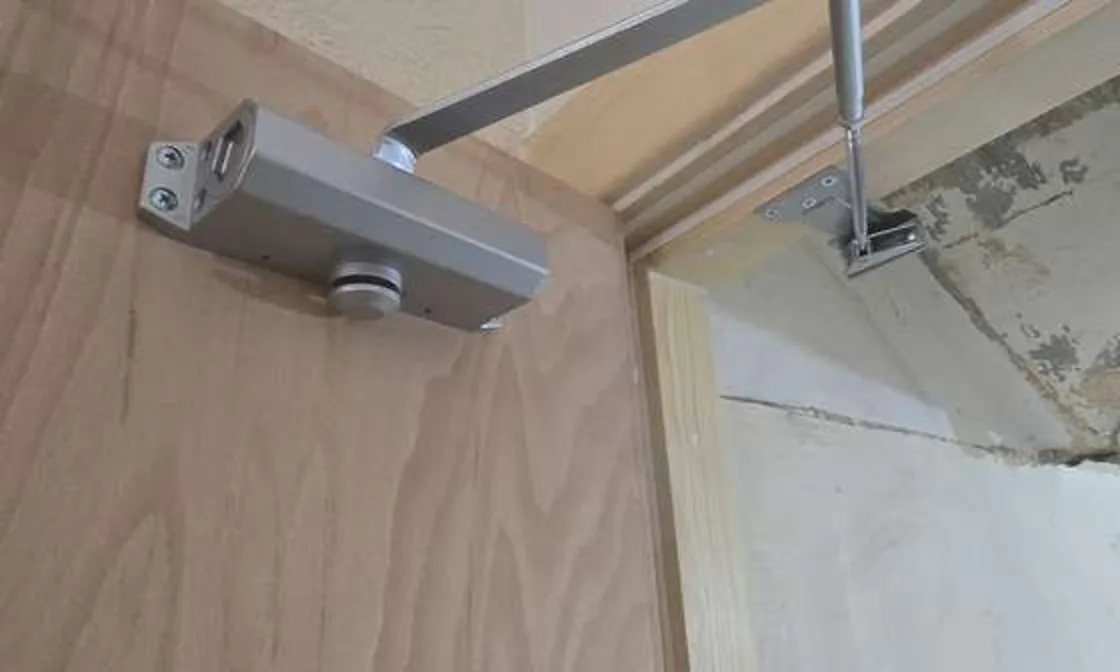
Most fire door failures we find across Liverpool are not caused by the door leaf. They come from the hardware: closers that leak or have been wound up to full power, hold-open devices that never release, kick plates screwed over damage and locks dropped into old mortices. This guide explains how each piece of fire door hardware works, how it wears, and what a proper repair looks like, so landlords, managing agents and Responsible Persons know what good maintenance should involve.
Our HMO fire door compliance guide covers inspection routines and how to log checks. This guide goes deeper into the moving parts.
1. Fire door closers: power sizes, types and adjustment
A fire door only protects an escape route when it is shut, and the closer is what shuts it. It is the hardest-working part on the door, and the part most often fitted or adjusted wrongly.
What the EN power size means
BS EN 1154 grades door closers by power size, from 1 (lightest) to 7 (strongest), chosen from the width and weight of the door leaf. For fire and smoke doors, closers must be capable of adjustment to at least power size 3. That is why you will often see “EN 2–4” or “EN 3–5” on a closer body: it is an adjustable closer whose spring can be set anywhere in that range.
| EN power size | Recommended max leaf width | Test door mass | Fire door use |
|---|---|---|---|
| Size 1 | 750mm | 20kg | Not suitable |
| Size 2 | 850mm | 40kg | Not suitable |
| Size 3 | 950mm | 60kg | Minimum for fire doors |
| Size 4 | 1100mm | 80kg | Heavier FD30 and most FD60 leaves |
| Size 5 | 1250mm | 100kg | Wide or heavy leaves, draughty corridors |
| Size 6 | 1400mm | 120kg | Large period openings, exposed fire exits |
| Size 7 | 1600mm | 160kg | Very large or exposed doors |
The table is a starting point. Tall Victorian leaves, doors at the top of a draughty stairwell and external fire exits caught by the wind may need a size above what the width alone suggests. The closer must also be one listed in, or covered by, the door’s certification.
Why more power is not safer
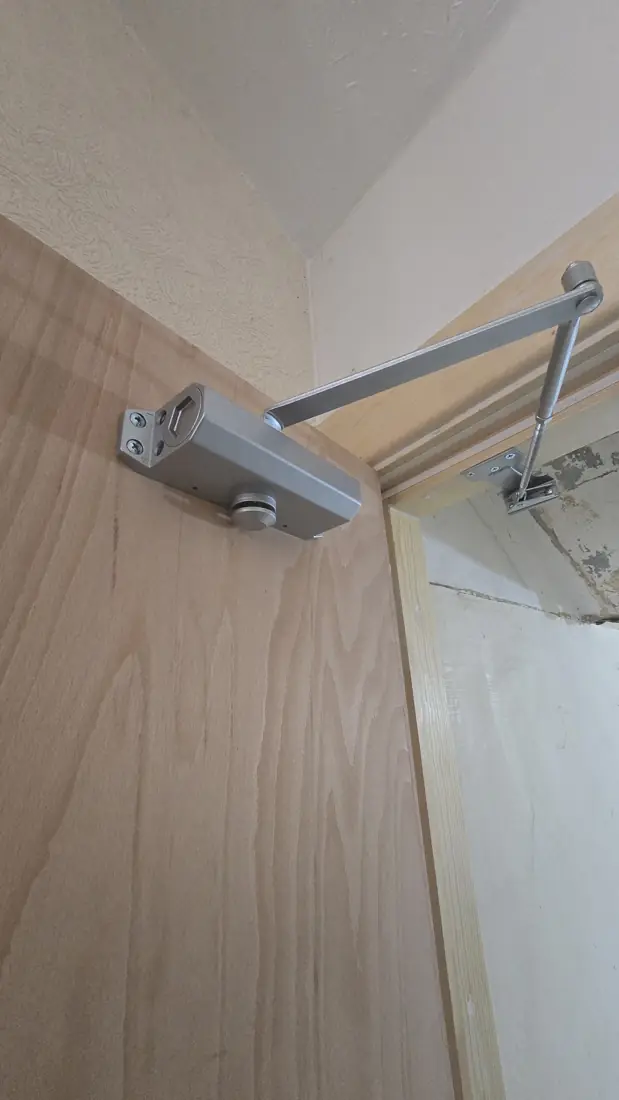
When a door will not latch, the common “fix” is to wind the closer up to full power. That swaps one problem for another. An over-powered closer makes the door heavy to open for children, older residents and wheelchair users. Approved Document M guidance asks for an opening force at the leading edge of no more than 30N from 0° to 30° and no more than 22.5N from 30° to 60°. Heavy doors also end up wedged open by frustrated residents, which defeats the closer entirely.
The proper fix is to find out why the door is not latching, such as a worn latch, a dropped door, a binding seal or a misaligned keep. Then set the closer to the lowest power that closes and latches the door reliably every time.
The four adjustment valves
- Closing speed controls the main swing from fully open to around 15°.
- Latching speed controls the final few degrees, set so the door picks up the latch firmly without slamming.
- Backcheck cushions the door when it is flung open, protecting the closer, hinges and wall. It is essential on doors that get kicked or barged.
- Delayed action slows the start of the closing swing for a few seconds. It helps in care settings, but the door must still close fully.
Valves are sensitive. A quarter turn makes a noticeable difference, and over-unscrewing a valve can release the hydraulic oil and ruin the closer.
Types of closer we maintain
- Overhead face-fixed closers (rack and pinion) are the most common, robust choice for communal doors, in regular arm, parallel arm and slide-arm versions.
- Cam-action slide-arm closers give strong closing force at the latch with lower opening force, so they suit residential and accessible buildings.
- Concealed jamb-mounted closers sit inside the edge of the leaf and frame for a clean look on flat entrance doors. Because they need routing into the door and frame, they must be covered by that door’s fire test evidence.
- Floor springs are used on heavy or double-swing commercial doors and need checking for water ingress, oil leaks and worn top centres.
- Spring-chain and other basic closers are often found on older flat doors. If they are not classified to BS EN 1154 at power size 3 or above, they need replacing.
Signs a closer needs attention
- Oil on the closer body or floor. A leaking hydraulic closer cannot be repaired and must be replaced.
- The door slams, or stops short of the latch from some opening angles.
- A loose or bent arm, or missing fixing screws on the body or arm shoe.
- Painted-over or snapped adjustment valves.
- The arm disconnected so the door “stays open”, a surprisingly common find in HMOs.
2. Automatic hold-open and free-swing devices
Some fire doors are a real nuisance kept shut: care home corridors, busy office kitchens and communal hallways used for deliveries. The answer is never a wedge, hook or fire extinguisher. It is an automatic device that holds the door open in normal use and releases it the moment the fire alarm activates.
The main types
- Electromagnetic wall or floor holders: a magnet on the wall or floor and a keeper plate on the door, hard-wired to the fire alarm. When power is cut, the magnet lets go and the door’s closer shuts it.
- Closer-integrated hold-open closers: the electromagnetic hold-open is built into the closer arm or track, holding the door at a set angle without a wall magnet. These must meet both BS EN 1154 and BS EN 1155.
- Free-swing (swing-free) closers: the door moves freely as if no closer were fitted, so it is easy to push for residents with limited strength. On alarm or power failure the closer engages and shuts the door. Ideal for care homes, supported living and bedroom doors.
- Acoustic battery-powered retainers: these listen for the fire alarm sounder and release the door. They are quick to fit with no wiring, but come with restrictions.
Where sound-activated devices are not allowed
BS 7273-4 sets categories of door release based on risk. Sound-activated devices are generally not suitable for the highest-risk (Category A) locations, including stairways in HMOs, hotels and care homes, the only stairway in a multi-storey building, and compartment walls between buildings. In those places the device should be hard-wired to the fire alarm. Your fire risk assessment should confirm the category for each door.
Maintaining hold-open devices
- Weekly: during the routine fire alarm test, check every held-open door releases, closes fully and latches. Record any that do not.
- Fail-safe check: the door must also release on loss of power, a cut cable or a fault. If it stays open, it must be taken out of use and put right.
- Manual release: staff must be able to release the door by hand, by button or a firm pull, at night or when a room is empty.
- Battery units: change batteries on the maker’s schedule, not when the device stops working, and re-test after any change to the alarm sounders.
- Holding angle: the open door should not narrow the escape route.
- Compatibility: keeper plates and fixings must be ones the door’s certification allows. Screwing through the leaf near the edge or seals can damage the assembly.
3. Kick plates, push plates and protection plates
Kick plates take the abuse from feet, bins, trolleys and wheelchairs so the bottom of the door does not. On a busy communal fire door they are often the cheapest way to extend its life, but they still need doing properly.
- Covered by the certification: the plate’s size, material and fixing must fall within the door’s fire test evidence. Metal conducts heat, so an oversized plate can change how the door behaves in a fire.
- Size limits: many fire door certificates cap kick plates at around 400–500mm high and a set share of the leaf face, with mid-rail plates smaller still. The door’s own certificate always takes priority.
- Fixing method: some certificates require adhesive, others allow screws of a set length and spacing. Long screws deep into the core, or fixings through intumescent strips, can void the assembly.
- Keep edges clear: plates must not cover or crush intumescent strips, smoke seals, hinges, the latch, the closer or the certification label on the door edge.
- Do not hide damage: a plate stuck over a hole or split in the leaf hides a defect rather than repairing it. Damaged core material must be assessed and repaired to the manufacturer’s method, or the leaf replaced.
The same rules apply to push plates, pull handles on back plates and leading-edge protection strips. Hinge-side finger guards in schools and nurseries also need to be types tested for use on fire doors.
4. Locks, latches and handles: fixes and replacement
Locking hardware is where we see the most damage to fire doors, usually from a rushed lock change after a tenant moves out or a break-in.
Common faults and the right fix
- Door closes but will not latch: often the door has dropped on worn hinges or the frame has moved, so the latch misses the keep. Correct the hinges and re-align the keep. Never file the latch or remove the keep.
- Sticky or sluggish latch: worn latch springs or a dry bolt stop it shooting into the keep. Clean and lubricate it to the maker’s guidance, or replace the latch like-for-like.
- Loose or drooping levers: worn spindles and lever springs. Replace with fire-rated levers to BS EN 1906, using bolt-through fixings where the certification specifies them.
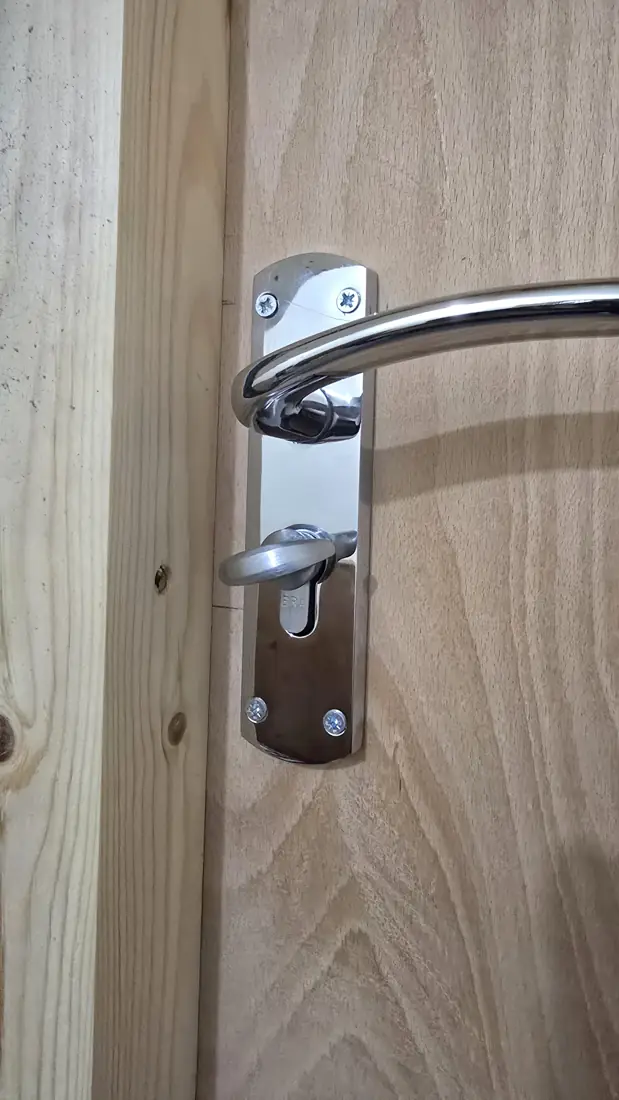
- Snapped euro cylinder or stuck key: replace the cylinder with one of the correct length, so it sits flush and does not leave a gap through the lock case.
Replacing a lock on a fire door
A replacement lock or latch must:
- Be classified for fire and smoke doors. Under BS EN 12209 the fourth digit of the classification code shows fire door suitability. Electromechanical locks follow BS EN 14846.
- Have metal locking parts in steel, stainless steel or brass rather than low-melting-point alloys that fail early in a fire.
- Fit the existing mortice exactly, or be fitted to the manufacturer’s tested method. A smaller lock dropped into an old, larger mortice leaves voids that let heat into the core.
- Be fitted following each door manufacturer’s recommendations.
Escape and security together
- Flat entrance doors: residents must be able to get out quickly without a key, which usually means a thumbturn or lever inside. Key-only deadlocking from inside is a real hazard in a fire.
- Extra locks, chains and bolts: tenant-fitted bolts, chains and second locks cut into the leaf can void the assembly and slow escape. Remove them and repair the damage properly.
- Access control and maglocks: electrically locked doors on escape routes must release on fire alarm and on power failure, and be tested with the alarm.
- Panic and emergency exit hardware: on commercial fire exits, push bars (BS EN 1125) and push pads or levers (BS EN 179) must release smoothly, with bolts that are not bent, painted or blocked.
- Meter cupboards and risers: keep them locked shut with a fire-rated lock. See our FD30 meter cupboard doors.
5. The wear parts people forget
- Door selectors on double doors: pairs with a rebated meeting edge must close in the right order. A missing or broken selector lets the second leaf shut first, so the pair will not seal.
- Door stops and buffers: without one the leaf swings past the closer’s range, bending the arm and straining the hinges.
- Letterplates and spyholes: on flat entrance doors these must be fire-rated with intumescent protection. A standard letterplate, or the hole left by a removed spyhole, is a direct path for fire and smoke.
- Air transfer grilles: intumescent grilles must be free of paint and dust so they can expand, and smoke-rated where the door needs smoke control.
- Hinges: replacements must be CE or UKCA marked to BS EN 1935 and match the size, grade and fixings in the door’s certification. Never mix hinge types on one leaf.
- Signage: faded, painted-over or missing “Fire Door Keep Shut”, “Keep Locked” or “Automatic Fire Door Keep Clear” signs should be replaced to suit how each door works.
Fire door hardware maintenance planner
| Component | Warning signs | Correct action |
|---|---|---|
| Overhead closer | Oil leak, slamming, stops short of latch | Adjust valves. If leaking, replace with an EN 1154 closer of the right power size |
| Hold-open device | Door stays open in alarm test or power cut | Take out of use, repair or replace, re-test with the alarm |
| Free-swing closer | Heavy in normal use, or does not engage on alarm | Check power and alarm interface, service or replace |
| Kick plate | Lifting corners, oversized, covering seals or damage | Refit or replace within the door’s certification and repair damage underneath |
| Lock or latch | Will not latch, sticky bolt, loose keep | Correct alignment, then replace like-for-like with a fire-rated BS EN 12209 lock |
| Lever handles | Drooping, loose, wobbling roses | Replace with fire-rated BS EN 1906 levers and correct fixings |
| Door selector | Pair closes in wrong order, leaves clash | Repair or replace the selector and adjust both closers |
| Letterplate or spyhole | Non-rated unit, missing flap, open hole | Fit a fire-rated unit with intumescent protection, or a tested repair |
Repair or replace: where the line is
Most hardware faults are repairable, and a well-maintained fire door assembly gives many years of service. Under BS 8214:2026, though, a repair must keep the door performing as the tested system it was certified as. We recommend replacing the complete fire door assembly when:
- The leaf has been cut so often for locks, closers and plates that there is no sound timber left to fix into.
- Oversized or multiple mortices cannot be repaired to a tested method.
- There is no label or certification, so replacement parts cannot be matched to evidence.
- The frame is damaged or out of square, so no hardware adjustment will make the door close and latch reliably.
For more on the system approach, read BS 8214:2026 explained.
How Liverpool Joinery Services maintains fire door hardware
We are UK Fire Door trained and FireQual-certified fire door specialists with over 20 years’ experience, working across Liverpool and Merseyside. On every visit our fire door maintenance service covers:
- Checking each closer is the right power size for the leaf, and setting it to close and latch without slamming.
- Testing hold-open and free-swing devices release on alarm and on power loss.
- Replacing locks, latches, levers, plates and closers only with parts covered by the door’s certification.
- Photographing and recording every component we change, so your fire safety records show exactly what was done.
Not sure what condition your doors are in? Book a fire door inspection in Liverpool first.
Fire door hardware playing up?
Talk to our fire door team today. We reply to all enquiries within 1 working day.
Sources
- DHF – Controlled door closing devices to BS EN 1154
- Guide to BS EN 1155: electrically powered hold-open devices
- Checkmate – Retrofitting fire-resistant locking systems
- DHF – Best practice guide on BS 8214:2026
- BSI Knowledge – BS 8214:2026
- GOV.UK – Approved Document M: access to and use of buildings
This article is general guidance and not a substitute for a fire risk assessment of your building.
