
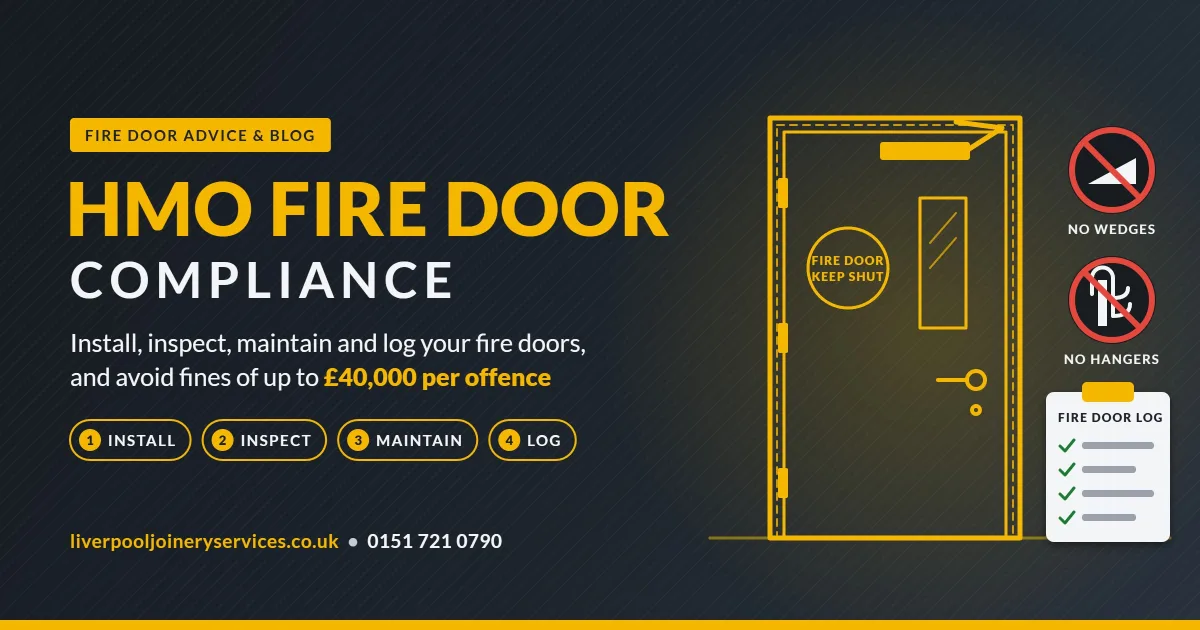
Fire doors are one of the most important fire safety measures in an HMO, and one of the easiest to let slip. This guide follows a fire door through its whole life in a house in multiple occupation: choosing and installing the right fire door assembly, inspecting it, maintaining it and, just as important, logging every check so you can prove it was done. It also sets out the penalties Liverpool City Council can impose, which went up in 2026.
The law on fire doors in a Liverpool HMO
There is no single “fire door law” for HMOs. Several overlapping pieces of legislation apply, enforced by two different bodies: Liverpool City Council and Merseyside Fire and Rescue Service.
| Law | Enforced by | What it means for fire doors | Penalty |
|---|---|---|---|
| Management of HMOs (England) Regulations 2006 | Liverpool City Council | The manager must keep the means of escape from fire free from obstruction and in good order and repair, keep fire alarms and fire-fighting equipment in good working order, and keep common parts, including the entrance door to each unit, in good repair. | Civil penalty up to £40,000 per offence, or prosecution with an unlimited fine |
| Housing Act 2004: licensing and housing standards | Liverpool City Council | HMOs with five or more people from two or more households need a mandatory HMO licence, and licence conditions must be met. Fire is one of the hazards assessed under the housing health and safety rating system, and the council can serve improvement notices. | Civil penalty up to £40,000, prosecution, rent repayment orders and loss of the licence |
| Regulatory Reform (Fire Safety) Order 2005 | Merseyside Fire and Rescue Service (common parts) | The Responsible Person must carry out and record a suitable and sufficient fire risk assessment, and keep fire safety measures, including fire doors, in efficient working order and good repair. | Unlimited fine and, for the most serious offences, up to two years in prison |
| Fire Safety (England) Regulations 2022 | Merseyside Fire and Rescue Service | Where there are two or more domestic premises with common parts, residents must be told to keep fire doors shut, not to tamper with self-closers and to report faults, when they move in and every 12 months. In buildings over 11m, communal fire doors must be checked every 3 months and flat entrance doors every 12 months. | Enforced under the Fire Safety Order |
Most rented homes in Liverpool are also covered by the council’s selective licensing scheme, which started in April 2022 and covers 16 wards and roughly 80% of privately rented homes. It runs until 2027, and the council has been consulting on what should replace it.
The Fire Safety Order was strengthened in October 2023 by the Building Safety Act 2022. Every Responsible Person must now record their fire risk assessment in full and record their fire safety arrangements, and failing to give an inspector what they ask for, such as your fire risk assessment, carries an unlimited fine.
Stage 1: Installation – getting it right from day one
Compliance starts the day the door goes in. A badly specified or badly fitted fire door is a defect from the first day, however often you check it afterwards.
Which doors need to be fire doors?
Your fire risk assessment decides this, usually following the national LACORS Housing – Fire Safety guidance. In most shared houses and bedsit-type HMOs, doors from bedrooms, kitchens and living rooms that open onto the escape route need to be FD30 fire doors, often FD30S with smoke seals. LACORS says that in most multi-occupancy situations, fire-resisting doors should have self-closing devices. Larger or taller HMOs may need more, including FD60 doors in some locations.
Fit a certified fire door assembly
A fire door only works as a complete assembly: the leaf, frame, hinges, closer, latch, intumescent strips, smoke seals and glazing working together. Under BS 8214:2026, every new installation needs evidence that all of these components have been tested together as one fire door assembly, and the door frame is always replaced. Fitting a new fire-rated leaf into an old frame, or mixing components that were never tested together, leaves you with a door you can’t prove will work.
Use a competent installer
Fire door installation is specialist work. Use installers who are trained and certified for it, and who will give you documents for every door they fit. Many older Liverpool HMOs are Victorian or Edwardian conversions with tall, wide doorways that standard doors don’t fit. Those openings need made-to-measure certified fire door assemblies, not a standard door packed out to fit.
Keep the handover pack
For every door, you should receive and keep:
- the certificate and data sheet for the fire door assembly, showing its rating (FD30 or FD60) and certification number;
- the certification label or plug on the door, which must not be painted over or removed;
- installation sign-off from the installer confirming it was fitted to the certification and BS 8214:2026;
- photos of the key components: hinges, closer, latch, seals, gaps and label;
- a door reference number that matches your floor plan and your fire door log.
This pack is the first entry in the door’s log, and the evidence a council officer, fire safety inspector, fire risk assessor or insurer will ask for.
Stage 2: Inspection – what gets checked
HMO fire doors take more punishment than doors in almost any other home. Several households use them, often on different schedules, and they get propped open, slammed, kicked and fitted with extra locks. A door that was perfect when installed can fail within months. Every inspection, whether it’s your quick check or a full one by a professional, should cover the following:
- Self-closer: released from any angle, does the door close fully on its own and engage the latch?
- Latch: does it hold the door shut without being locked?
- Gaps: are the gaps between the door and frame along the top and sides generally 2–4mm and never more than 4mm? Is the gap under the door within the limit in the manufacturer’s data?
- Intumescent strips and smoke seals: present, continuous, not painted over and not damaged.
- Hinges: all present, secure, not leaking oil and with no missing screws.
- Leaf and frame: no holes, splits, delamination, gaps where the frame meets the wall, or unauthorised alterations.
- Glazing: fire-rated glass intact and the beads secure.
- Ironmongery: no extra locks, chains, spyholes or letterplates added that the door’s certification doesn’t allow.
- Label and signage: certification label still readable, and “Fire door keep shut” signs in place where needed.
- Use: no wedges, hooks or door stops holding the door open, and no closers disconnected by tenants.
A professional fire door inspection goes further than this, checking each door against its certification and giving you a dated report, door by door.
Stage 3: Maintenance and repair
Finding a fault is only half the job. The law requires fire doors to be kept in good repair, so defects need to be put right promptly and the repair recorded.
- Fix faults quickly. A closer that doesn’t latch or a missing seal makes the door far less effective until it’s repaired. Prioritise doors on the main escape route.
- Use compatible parts. Replacement closers, hinges, seals and locks must be suitable for the door’s certification. Fitting an untested part can mean the door no longer matches its certification.
- Don’t let others alter doors. Make it clear to tenants, cleaners and other trades that fire doors must not be drilled, cut down for new flooring, fitted with extra locks or have their closers removed.
- Know when to replace. Some doors can’t be made safe again, such as doors with large splits, gaps that can’t be closed, or frames pulling away from the wall. Those need replacing with a new certified fire door assembly.
Our fire door maintenance service covers adjustments, repairs and replacements, with sign-off documentation for every door we work on.
Everyday use: wedges, coat hooks and over-door hangers
Most fire door damage in HMOs isn’t caused by fires. It’s caused by everyday habits. A door can be perfectly installed and inspected last month, and still be failing today because of how it’s being used.
Wedging or propping fire doors open
A fire door only protects anyone when it’s shut. A door held open with a wedge, a doorstop, a chair or a bin bag does nothing to stop fire and smoke spreading along the escape route, often while people are asleep. Tenants usually prop doors open because a closer is too strong, the room is hot or they’re carrying shopping. Wedging also strains the closer and hinges over time, so the door eventually stops closing and latching on its own.
If a door genuinely needs to stay open in normal use, the safe answer is an approved hold-open device linked to the fire alarm, which releases the door so it closes when the alarm sounds. It must be suitable for the door’s certification, covered by your fire risk assessment and fitted by a competent person.
Coat hooks and over-door hangers
Over-door coat hangers, towel rails and hook racks are cheap, popular and a real problem on fire doors. A fire door is made to close tolerances, with gaps between the door and frame of generally 2–4mm. A metal hanger hooked over the top of the door sits right in that gap. Every time the door closes, it:
- crushes and tears the intumescent strips and smoke seals in the frame or door edge;
- dents and splits the frame and the top edge of the door;
- forces the gap open, so the door may no longer close fully or engage the latch;
- puts extra load on the hinges and closer.
The damage builds up slowly and is easy to miss, but a door with crushed seals and a stretched gap may not hold back smoke or fire for anything like its rated time. Screw-in hooks, nails and adhesive hooks cause their own problems by putting holes in a tested door leaf. The simple fix is to provide wall-mounted hooks or a freestanding coat stand in each room, so tenants don’t need to hang anything on the door.
Give tenants a fire door guidance sheet
Tenants can’t look after fire doors if nobody has told them how. Landlords and agents should give every tenant a short, plain-English fire door guidance sheet at the start of each tenancy, and keep it on display in the common parts. Where an HMO has two or more households sharing common parts, the Fire Safety (England) Regulations 2022 already require residents to be told to keep fire doors shut, not to tamper with self-closers and to report faults, when they move in and every 12 months. A guidance sheet is the easiest way to meet that duty and prove it.
A good guidance sheet should:
- explain what a fire door is and show which doors in the property are fire doors;
- ask tenants to keep fire doors closed and never to wedge or prop them open;
- ask them not to hang anything over or on a fire door, including coat hangers, hooks and towel rails;
- tell them not to remove, disconnect or adjust door closers, or fit extra locks, chains or bolts;
- tell them not to paint over seals or the certification label;
- explain how to report a door that slams, sticks, won’t close or latch, or is damaged, with a phone number or email for reporting;
- let them know fire doors will be checked during inspections and visits.
Ask each tenant to sign and date the sheet, keep a copy in your fire door log, and add a matching clause to the tenancy agreement or house rules. If a door is found damaged or wedged during a check, record it, repair it and remind the tenants in writing. That paper trail shows the council and fire service that you’re actively managing your building and keeping it compliant.
How often should HMO fire doors be checked?
Apart from the rules for buildings over 11m, the law doesn’t set a fixed inspection frequency for HMOs. The Management Regulations require fire doors to be kept in good order and repair at all times, and your fire risk assessment should say how often they are checked. In our experience, this schedule keeps most Liverpool HMOs safe and is easy to show to an officer:
| Check | Who | How often |
|---|---|---|
| Quick visual check: closing, latching, wedges, obvious damage | Landlord, manager or agent | At every property visit, and at least monthly |
| Detailed check of communal and escape route fire doors | Competent person | Every 3 months. This is a legal minimum in buildings over 11m and good practice in larger HMOs |
| Full inspection of every fire door, including bedroom doors | Competent fire door inspector | Every 6 to 12 months, as set by your fire risk assessment |
| Check after a reported fault, damage, forced entry or change of tenant | Landlord or manager | Straight away |
Logging checks properly: if it isn’t written down, it didn’t happen
When a council officer or fire safety inspector visits your HMO, they don’t just look at the doors. They ask what you have been doing to look after them. Since December 2025, councils can also require landlords and agents to hand over compliance records. A clear fire door log is the evidence that you have met your duty. Without one, you are relying on your word against what the inspector finds on the day.
What a good fire door log contains
- A door schedule: a reference number for every fire door, its location on a floor plan, its rating (FD30 or FD60) and its certification number.
- The installation records: certificate, data sheet, sign-off and photos from the handover pack.
- Every check: date, who carried it out, what was checked and the result for each door.
- Every defect found, with a photo.
- Every repair: what was done, which parts were used, who did it and the date it was completed and re-checked.
- Tenant information: when residents were told about keeping fire doors shut and reporting faults.
- Any time access was refused to a room or flat, and what you did next.
An example log entry
| Door | Date and checked by | Result | Action and completed |
|---|---|---|---|
| D04 – Bedroom 3, first floor, FD30S | 3 Oct 2026, managing agent (monthly check) | Fail: door not latching from 45°, closer too weak | Closer adjusted and re-tested, closes and latches from any angle. Photo saved. Completed 3 Oct 2026 |
| D01 – Front entrance, FD30S | 3 Oct 2026, managing agent (monthly check) | Pass | None needed |
Tips for keeping it right
- Use the same door numbers everywhere: on the floor plan, in the log, on inspection reports and on invoices for repairs.
- Take dated photos. They are far more convincing than a tick in a box.
- Keep the log digital, backed up and easy to share, with a copy available for the property.
- Review the log whenever your fire risk assessment is reviewed, and hand it over if you sell the building or change agent.
What happens if you don’t: HMO fire safety penalties in Liverpool
Liverpool City Council enforces housing standards in HMOs. Where it finds fire doors or other fire safety measures that have not been kept in good order and repair, it can issue a civil penalty instead of going to court, or it can prosecute.
| Period | Maximum civil penalty |
|---|---|
| Before 1 May 2026 | Up to £30,000 per offence |
| From 1 May 2026 (Renters’ Rights Act 2025) | Up to £40,000 per offence |
What the penalties cover
- Civil penalties of up to £40,000 per offence apply to Housing Act offences, including breaching the HMO Management Regulations, licensing offences and ignoring an improvement notice. Each breach of the regulations can be charged as a separate offence.
- Rent repayment orders of up to two years’ rent, which councils and tenants can apply for across a wider list of offences.
- Stronger investigation powers, including the power to require landlords and agents to produce documents. That is exactly where an up-to-date fire door log protects you.
- Prosecution can still lead to unlimited fines. Under the Fire Safety Order, the most serious offences can also lead to up to two years in prison.
A fine is not the worst outcome. Fire doors exist to hold back fire and smoke long enough for the people in your building to escape. In an HMO, that means people asleep behind a bedroom door relying on the doors between them and the way out.
Your HMO fire door compliance checklist
- Make sure you have a current, suitable and sufficient fire risk assessment, recorded in full, that says which doors must be fire doors and how often they are checked.
- Check your licensing position: a mandatory HMO licence, a selective licence, or both. Read your licence conditions.
- Fit certified fire door assemblies to BS 8214:2026 wherever fire doors are needed, using a competent installer.
- Keep the handover pack for every door, including the certificate, data sheet, sign-off and photos.
- Number every fire door on a floor plan and set up a fire door log.
- Carry out quick checks at every visit, plus regular professional inspections.
- Repair faults quickly with compatible parts, and replace doors that can’t be made safe.
- Give every tenant a signed fire door guidance sheet at the start of each tenancy, and remind residents every 12 months to keep fire doors shut, not to hang anything on them, not to tamper with closers and to report faults.
- Provide wall hooks or coat stands so nothing gets hung over fire doors.
- Record every check, defect and repair, with dates and photos.
How Liverpool Joinery Services can help
We are UK Fire Door trained and FireQual-certified fire door specialists with over 20 years’ experience, working with HMO landlords and managing agents across Liverpool and Merseyside. We can cover the whole life of your fire doors:
- Installation: certified fire door assemblies, including made-to-measure doors for period properties, fitted to BS 8214:2026 with full sign-off documentation.
- Inspection: door-by-door fire door inspections and surveys with clear, dated reports you can add straight to your log.
- Maintenance: repairs and adjustments using compatible parts, recorded and signed off.
Not sure whether your existing doors are certified at all? Read our guide to nominal vs notional fire doors, or see our fire door regulations FAQs.
HMO fire door questions answered
Do bedroom doors in an HMO need to be fire doors?
In most HMOs, yes. Doors from bedrooms, kitchens and living rooms that open onto the escape route usually need to be FD30 fire doors, normally with self-closing devices, following LACORS guidance. The exact requirement depends on the size, layout and use of the property and is set by its fire risk assessment.
How often should fire doors be checked in an HMO?
Apart from buildings over 11m, where communal fire doors must be checked every 3 months and flat entrance doors every 12 months, the law does not set a fixed frequency. We recommend quick visual checks at every visit and at least monthly, and a full inspection by a competent person every 6 to 12 months, as set by your fire risk assessment.
Who is responsible for fire doors in an HMO?
The person managing the HMO, usually the landlord or managing agent, must keep the means of escape from fire, including fire doors, in good order and repair under the HMO Management Regulations 2006. The Responsible Person under the Fire Safety Order has duties for the common parts. Tenants must not damage doors or disable closers, but the legal duty to maintain them stays with the manager.
Can tenants put coat hooks or over-door hangers on a fire door?
No. Over-door hangers sit in the tight 2–4mm gap between the door and frame, crushing the intumescent strips and smoke seals, damaging the frame and stopping the door closing and latching properly. Screw-in and adhesive hooks put holes in a tested door. Provide wall hooks or a coat stand instead, and explain this in a fire door guidance sheet for tenants.
How much can Liverpool City Council fine a landlord for HMO fire safety breaches?
Since 1 May 2026, the council can issue a civil penalty of up to £40,000 per offence (up from £30,000), or prosecute, where fines are unlimited.
Do I need to keep records of fire door checks?
Yes. In buildings over 11m, records of flat entrance door checks are a legal requirement. In every HMO, a written, dated log of checks and repairs is the only practical way to prove to the council or fire service that you have kept your fire doors in good repair, and councils can now require landlords and agents to produce compliance records.
Need your HMO fire doors checked?
Talk to a UK Fire Door trained and FireQual-certified team with over 20 years’ experience. We reply to all enquiries within 1 working day.
Sources
- legislation.gov.uk – The Management of Houses in Multiple Occupation (England) Regulations 2006
- GOV.UK – Fire Safety (England) Regulations 2022: fire door guidance
- London Fire Brigade – Changes to fire safety law (Building Safety Act 2022, section 156)
- LACORS – Housing: Fire Safety guidance
- Propertymark – Licensing expands as penalties increase under Renters’ Rights Act
- Stephens Scown – Renters’ Rights Act changes from 27 December 2025
- The Negotiator – Liverpool considers extending selective licensing scheme city-wide
This article is general guidance and not legal advice or a substitute for a fire risk assessment of your building.
